Raising Honeybees in the Suburbs

After taking a few entomology classes at the University of Minnesota. I discovered with fascination the world of insects, especially honey bees. It will be my seventh year as a beekeeper and I am sure a new adventure as well.

Thursday, March 17, 2011

Spring Cleaning is Done!


Look at the Little Darlings!
March 16, 2011 : It was the first  50 F ( 10 C) in a very long time. So, it was decided that it was an excellent day to clean up the colonies! Sophie is home for Spring break and was Ben's helper. Although a little scared of (any) insects, she did very well and took pictures.
In Shakopee, the dead colony was cleaned up, and all the boxes and frames were taken back home, and stored in the garage. There was some honey left over on few frames, so we will be able to use them on our other colonies, or give them to our new honeybee package. Pollen patties were replenished, but Ben noticed that the honeybees only nibbled at them. It is good news... it means they still have enough stored honey.

Frame of Honey


In Chanhassen, the same happened. Cleaning, and moving frames full of honey closer where the bees are located, on the very top of the hive. The honeybees are more daring everyday, flying a little longer, and farther. Soon, they will forage for themselves, in the meantime we will help them.

Buds on trees are visible to the naked eye and plump a good sign that  Spring is here to stay, finally.

Tuesday, March 15, 2011

Spring is on the Way!

Watch for buds!
This week in Minnesota seems to indicate that we are on our way to Spring! The days are getting longer and warmer. If you take the time to look at trees, some have already fat buds showing like maple trees, basswood, poplars and so on. However, the real good source of food for our bees are the dandelions which will bloom around April 10. So if you see one, please smile!
 The honeybees are flying around the hive in the afternoon when the temperatures are at their warmest. They certainly don't venture too far, but they just take a good look outside and cleansed themselves after a very long winter cooped up into the hive.


Dead bees on bottom board
March 8, 2011: Ben went to clean up the dead colony. Removing the dead bees at the bottom of the hive and brushing every frame carefully. we don't want to damage the work they have done, making the combs with wax. That can be reused by other bees that we will hive (install) mid-April when we get our new package of bees.


Left lower corner of frame: honey
In that particular colony, there is still some honey but for some reason the bees could not get to it. Therefore perishing from hunger. We can use that honey left in the frames to help our other colonies until the nectar flow.


Pollen patty
Since, my husband  had time and it was a beautiful sunny day (40F,  4C), he gave each hive 8 oz (228 g) of pollen patty. This is a source of protein that will help the honeybees survive until they can fetch their own food. We will gave some heavy syrup later in the month.

We will take the time to do a good inspection of each hive sometimes this week as weather permits.


Monday, February 21, 2011

THE BEES ARE ALIVE!

 
Chanhassen Apiary

Feb 12-13, 2011. It was 52F (11C) and it was the perfect weekend  to visit our bees. We walk in deep snow; I joked that it would have been easier with snowshoes! All week the snow had been melting due to a warm front. In Chanhassen, both colonies are alive and well. However in Shakopee, we lost one. It was not too surprising to us, as it was the one which had struggled all season by losing a queen, then queen killed, re-queening, mites and  invasion/robbing. However this colony did not die of a disease but rather from hunger. If you recall in the fall, the Italian bees next door were stealing their honey. I have to admit that seeing hundreds of dead bees with their heads deep into the comb looking for food is a very disturbing sight. But I have to remind myself that it is also nature. Mother Nature takes care of its less able living things.

Now the big hurdle will be the next 2-3 weeks when we have to wait before we can feed them. I hope the honeybees are wise and are eating carefully and pacing themselves..their pantry is running low on food. Overall, we are very happy that they made it so far, especially when I hear that many beekeepers had another big loss this year. I count my blessings.

Look at all those honeybees...you should have heard them!


Shakopee Apiary
Bees looking for food...and found none.
This colony in Shakopee is alive, however an intruder tried to get into it. We were told: probably a red squirrel! I am glad it was not a bear!
                                                               

Saturday, January 01, 2011

Happy New Year 2011


WE WISH ALL OUR FRIENDS AND FAMILIES A WONDERFUL HAPPY NEW YEAR !

Friday, December 24, 2010

Merry Christmas!

December 24, 2010

I wanted to let you know that the bees are fine and cozy in their respective beehive. As many of you know, here in Minnesota we have had a lot of snow so far, and somewhat colder temperature than usual.
The snow is fine for the bees, it acts as a natural insulator. As for the cold, well the honeybees have to cuddle a little tighter, and rotate like penguins to keep their little clustered buddies warm. With their constant movements, the bees generate warmth...if we were to put our hand inside the beehive into the cluster, we would be surprised to feel 80 degree F (23C). However, the hive itself is cold just like the outside temperature. Unlike us who need a heated home during winter, the honeybees need to be warm themselves to survive. By eating the honey that we left them, and moving their tiny legs, they have that incredible capacity to survive the cold.

We wish our friends and family a Merry Christmas!

Saturday, November 06, 2010

The Last Chore

On the first week of November, Ben and I did our last chore at the apiaries. It was a beautiful sunny day but somewhat a little cold 42 F (5 C), but I had to remember that it was November. As we approached the 2 colonies in Chanhassen, Ben who was walking in front of me and seeing the hives before I did, got a little agitated. "Where are the bees? I don't see any bees...Oh! They 're all gone, I can't hear them...where are they?" We opened the first hive body... nothing...no bees, no sounds. We removed the first hive body and put it aside, and there our bees were sitting pretty and calm on top of the second box. They had managed to scare us, one more time! But then they saw us and came out, flying gently around us, as to say: "Hey, we are here do not worry!" I whispered to them to have a safe and healthy winter, and that we will be back in the spring. I petted few of them gently. It is funny, I think they knew that was it for the season.

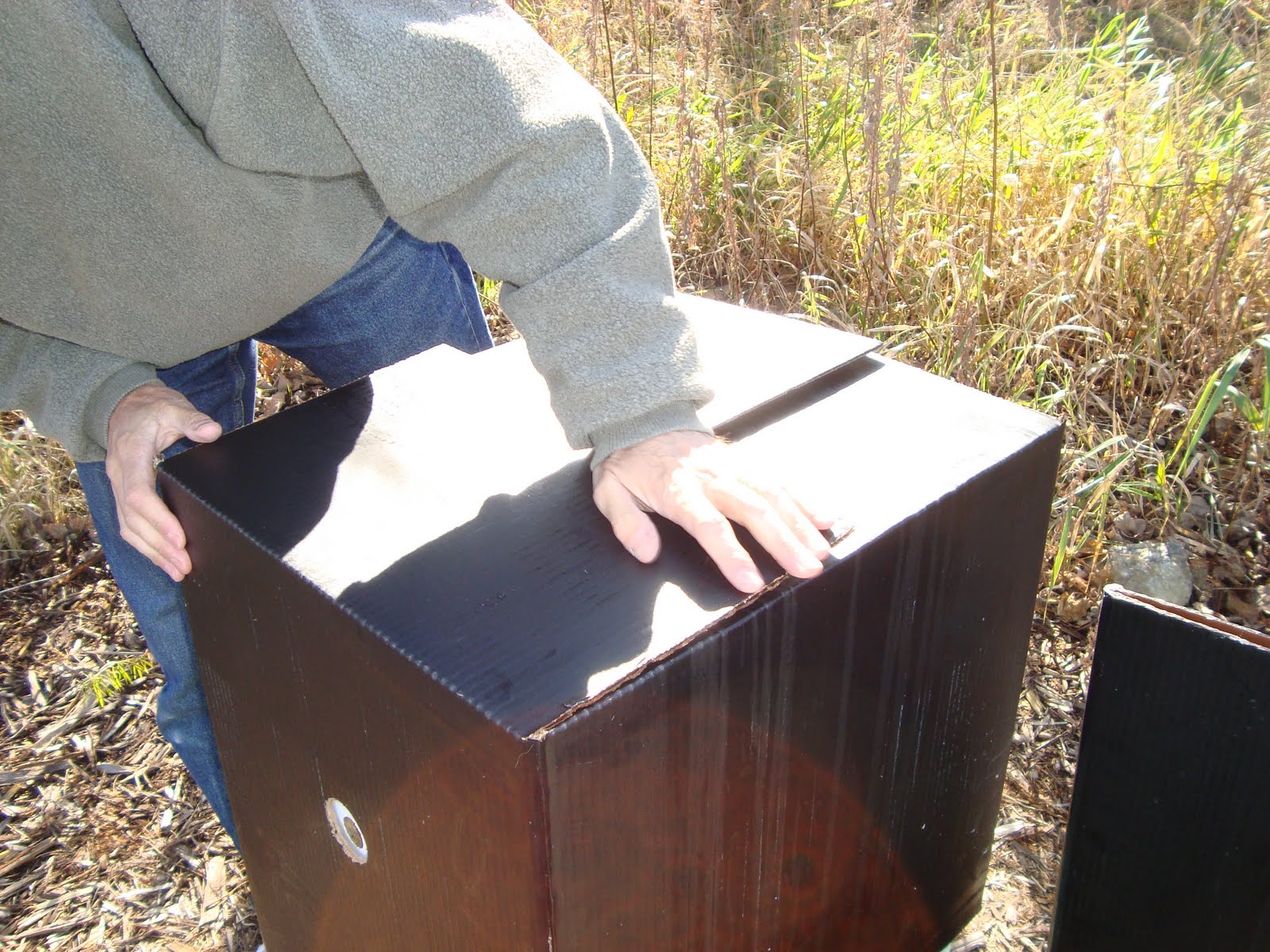
After my goodbyes Ben proceeded, to place an absorbing wood board on top, and then slid a waxed cardboard carton over each hive to protect the honeybees against the frigid Northwest wind. He replaced the covers and put many rocks and bricks on them to make sure they will stay put. We then backed away, looked at the hives one more time wishing them well. We walked slowly to our car. That was it, the season was over. There is nothing else we can do for our precious honeybees. They are on their own, and we really wish them to be successful and be healthy and strong come next spring.

We repeated these last same steps in Shakopee. The golden Italian bees had returned to their own hive. The darker Carniolans were at peace in their own hive... they have fought an aggressive invasion in October, many died and they lost some honey. Hopefully they will have enough food to survive. I waved goodbye, and wished them well.

What an adventure it has been, and despite the ups and downs, the unknowns, and strange happenings; we enjoyed every minute of it. And along the way the bees taught us a lot: first of all they are a capable species that is combative, hard working and self reliant.

We wish to all our friends and families a good, safe and healthy winter. Thank you for being interested in bees. During the winter months I will be posting what we are doing and thinking for next year, and please if you have any questions, I would be happy to answer them.

"Bee" well,
Karine


In Chanhassen

1. Ben placed a moisture board on top.


2. Now the cardboard.

3. Ben closes the carton, leaving the exit hole open.
4. Voila! Ready for winter.


In Shakopee
1. Moisture board in place, and carton next.


2. Yes! well done!

3. Placing the cover a little
"crooked" to let the moisture escape.
Look at those 2 beekeepers....they look so proud!!!!

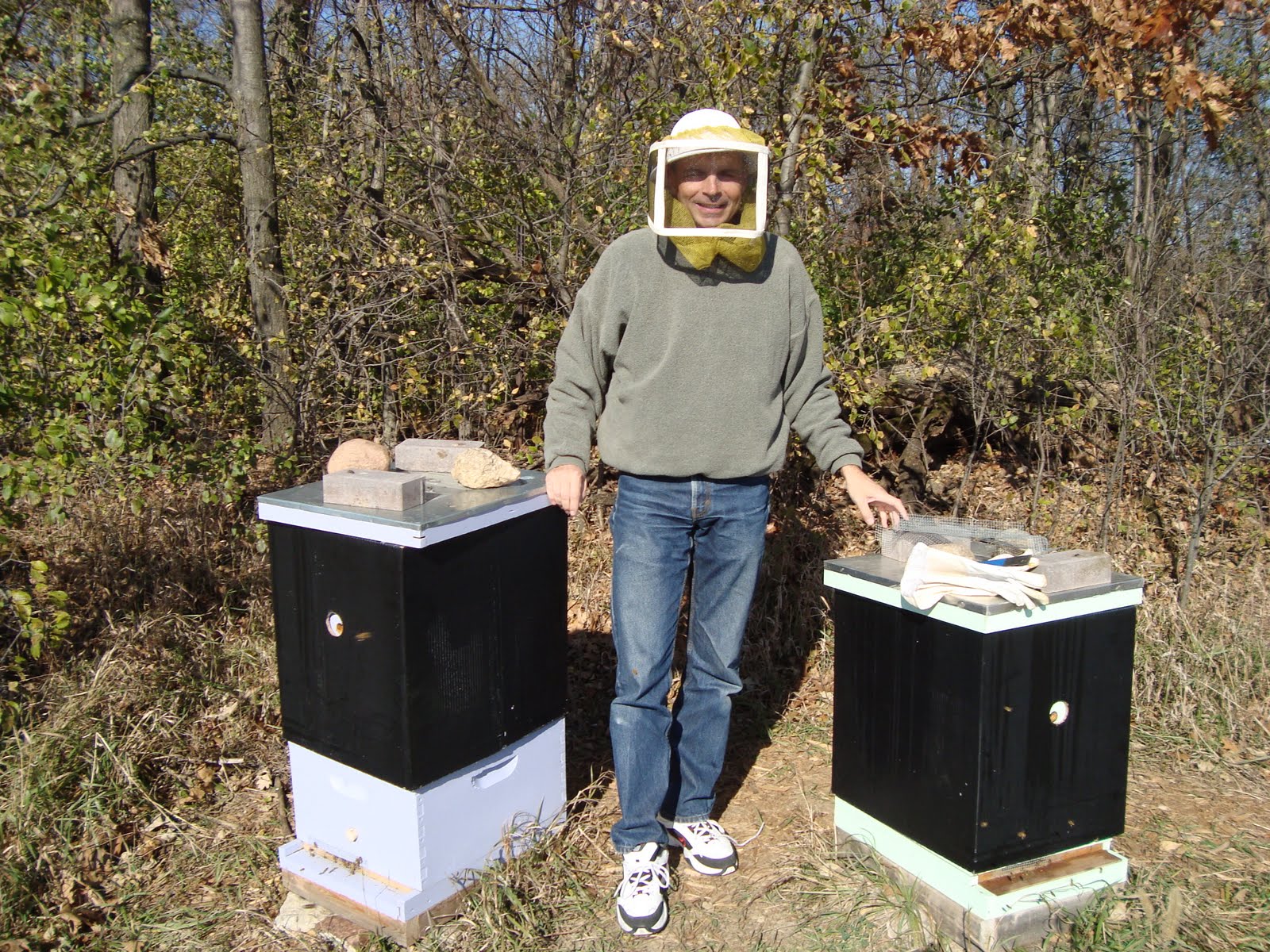
Karine at the Chanhassen apiary and Ben at the Shakopee apiary.


Friday, November 05, 2010

Be Well, Have a Safe Winter

Look our 2 hives in the background

November is finally here, and the honeybees have slowed down considerably. Even if like other insects, they are cold-blooded; they do not die off or hibernate like them. They are active all winter eating and transforming their accumulated honey and pollen to keep warm.

Since the cold weather started the honeybees have organized themselves in a tight cluster, moving their "back legs" muscles intensely to generate heat and to warm the cluster. Unlike us who need a warm home during winter, the bees need only to be warm themselves, and sharing this warmth among the group.

Something extraordinary happens to bees at the end of summer. The bees that are born in the Fall are different than the bees born in the Spring or Summer. So the so called "Winter" bees have a different blood protein, they are fatter which help them during the non-foraging months. They also live longer, from 4 to 6 months. Summer bees' life expectancy is about 45 days! However, those Winter bees have a daunting task... they have to get the colony through the winter. But they have prepared themselves since about August; the population is now smaller, and brood production is halted. Everything has slowed down.

Honeybees are geniuses! The cluster that they form will expand and contract as the outside temperatures go up or down. As temperature decreases , the cluster thus becomes tighter and tighter. The inside of the cluster is able to maintain a temperature of 85-90F! While the outside layer of bees can reach and maintain 55F. Extraordinary! The bees rotate...they take turn to be on the outside, protecting the core where the queen is located during the whole winter. This outer "coat" of bees always touches the honey stores. The honeybees eat during that time making sure to pace themselves as to preserve the food which HAS to last until April. That's 6 months of food reserve! I don't have 6 months of reserve in my pantry... How about you?