Raising Honeybees in the Suburbs

After taking a few entomology classes at the University of Minnesota. I discovered with fascination the world of insects, especially honey bees. It will be my seventh year as a beekeeper and I am sure a new adventure as well.

Friday, March 23, 2012

Spring, Thinking, and Honeybees

Silver maple buds, Acer saccharinum


Honeybees (Apis mellifera ) are not native to the Americas, they have been imported from Europe around 1640 . Since then, the honeybee known by most of us is a part of our environment, and no one thinks twice about it. Until recently, beekeeping in the United States was "simple" and straight forward: get bees in form of package or catching a swarm, put them in a hive and let them be (no punt intended!).


However, in the last 20-25 years our honeybees seem to " demand" a lot of care and strategies just to stay alive. Some "older" beekeepers at my Beekeepers' Club always talk about the days when they had bees growing up and that their hives were located in a spot on their family land that was unused by farming. Never looking at them, more than twice a season! Once in the Spring to make sure they were alive (if not they were looking for a swarm on a tree) and then at harvest, in the Fall! They find beekeeping very tedious, discouraging and expansive. Many quit, or have only a couple of hives. I feel their pain, having lost colonies myself...


I was pondering one afternoon, after  having learned the faith of my hives (2/6 alive). Why? I started to think about diversity and genetics, and the lack of, in the last 250 years! Yes, that's right the queen producers ( maybe 75 or 100 producers) mostly living in warm climate to help their queens mate early, in order for us, beekeepers of temperate places to have bees in April after winter, were the biological  ancestors of the first comers. Of course those queens were and are chosen for their good temperament, fertility, and health. However the pool of genes is shrinking; drones are all related, and their population is smaller.  No new "blood" has been added to the general population of honeybees. In addition, the Varroa mites made its entrance to our world, weakening our honeybee population further.

I was thinking that to improve genetic diversity around my location , I should try to get a different type of bee. Even though the Italian bees are the most common, and loved in the US, others exist. But for some strange reasons are not well "promoted".

After ample reflection, I decided to purchase a 3 pound package of Russian honeybees that I will place by itself on a beautiful land restored with native plants. They will come by mail!
I also ordered 4 packages of MN Hygienic bees developed by Dr. Marla Spivak at the University of Minnesota.  For those, we will drive to Stillwater, MN  to pick them up. We will then have 5 packages to hive in April! 


Tuesday, March 13, 2012

Visit Shakopee with a Friend!

A very good helper!
I went to visit the bees in Shakopee with my friend Mary today! After few attempt at lighting the matches, we finally got the smoker going. We walked the long dryer but bare pumpkin field; glad we had our boots. What a fabulous welcome...the bees were buzzing around in the warmth air. We could see very  light yellow pollen on their hind legs. They were bringing a lot of  it.  Mary was using the smoker and I was removing the cartons and moisture boards. I did not pull out any frames, the bees don't need to be bothered too much so early in the season. Let them be bees :)
The green hive, more populous had devoured the pollen patty that Ben and I had put only a week ago! I gave the honeybees a full pollen  patty, one pound. However, the purple hive which has less bees was also bringing in  pollen as well, but they did not eat as much. So, I just gave them 1/2 a patty. Now that their black covers and their moisture boards are removed, I hope Spring is really here to stay. Mary and I watch the honeybees for a while...they were really busy. And that's a good sign.

Saturday, March 10, 2012

Spring brought sadness and also Hope


Looking at our bees in Shakopee
 We visited our bees for the first time since November 2011, this past Tuesday March 6 2012. We loaded the car, happy and somewhat giddy. We stopped first in Shakopee...a good thing we were wearing our rubber and leather boots. The field was so muddy that when we got to the hives, we had gained 20 pounds...of mud on our feet!
It was 59F (15C), blue sky, light breeze...the perfect day. We saw many honeybees flying and buzzing around. What a happy site! We were so certain that they would be quiet, and mostly inside the hives that we did not take our smoker and hive tools. Seeing all that wonderful commotion, we retreated back to the car through the mud and all to gather our equipment.

In my excitement when getting the car ready in the morning, I had completely forgotten to bring some fuel (newspaper, and lint) for the smoker. However, having a former boy scout as a husband can be useful(!); he used some dried twigs, few leaves...and voila! We were in business again. We got our veils and gloves and some pollen patties. The field was wet, but our hives are elevated and somewhat on the "side" of the field protected by trees, therefore on  dry land.


Bees flying around in Shakopee
We opened the first hive and lots of bees were present. They were mostly curious, and were flying around us, looking for something, and wondering what were we doing. We put a piece of pollen patty, which is protein. It is nutritious for the bees before they can find the pollen on flowers. 

Ben opening the colony
Smoking the bees!


We inspected the second hive, although smaller in size, the colony was well, and alive. We also gave the honeybees a pollen patty. We left Shakopee, happy and full of hope...they had survived a crazy winter.
On our way to Chanhassen we felt joyful and confident. Arriving at the farm, Ben started the smoker and I gathered the pollen patties and hive tools. We were still cheerful, the sun was shining on our faces, and we were checking on the bees: priceless!

Hives in Chanhassen

However, our happy-giddy demeanor became bleaker as we were approaching the apiary tucked to the side by the trees. It was gloomy, no sound, no buzzing, no bees. "Where are the bees? I can't see them" I was repeating again and again. I did not believe that they did not survive, we rushed to the second hive, no bees either, and to the third...no bees. Now all was quiet, nothing moved, and a sadness descended upon us for a few second. We were stunned. We had lost 3 hives this winter, and one in the fall. 4 out of 6! We had lost 67% of our bees in about 6 months :(

After this initial shock, we got busy and started cleaning each hive, one at a time.


1. The purple: Lots of dead dry bees, on the bottom board. A mouse had found a house among warmth and honey. She had devoured some honey in her newly found den, and was a survivor. Probably died early winter. Still lots of stores:pollen and nectar.

Mouse chewed the combs, enjoying our honey!

Close up, chewed comb by mouse

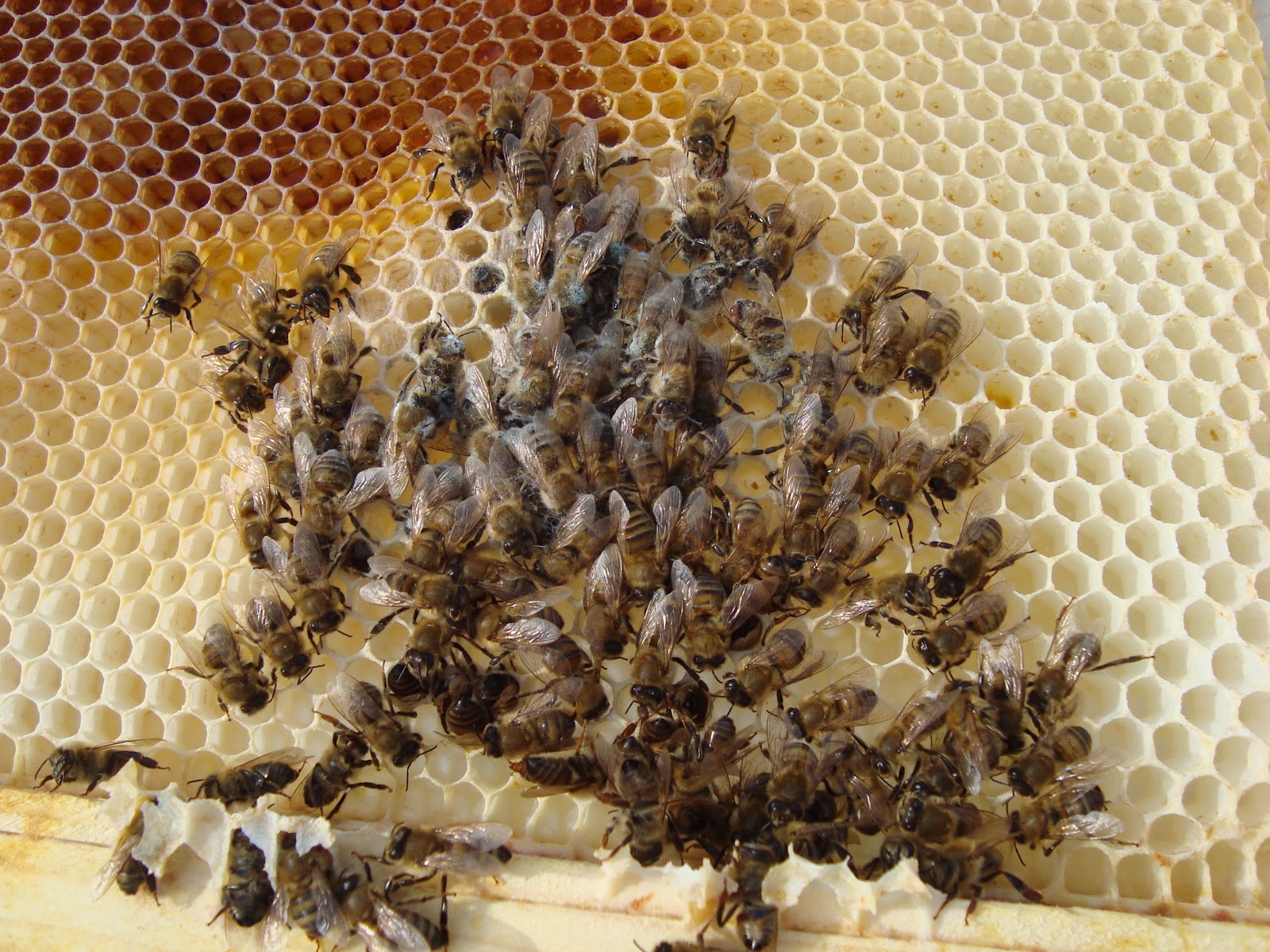
2. The white: Not too many dead bees, but small population of adults. We noticed that this hive had some new brood from this spring, and plenty of food. But probably not enough adult bees to keep them warm. And when a cold snap or cold nights came again, the honeybees' duty were to protect the brood and thus did not move to the food, and died in situ. Sad.

Small adult population


Bees trying to protect the small brood: losing their lives in the process. Notice on the lower right side: little butts poking out...bees starved looking deep for food.
Small amount of brood:dead
3. The green: This hive too had plenty of food. The boxes were heavy. It also had an occupant..a very, very scared mouse wet and cold. As the other one she sprinted as fast as her little legs could carry her far away in the field. I think that she had just made her nest, we found a ball of twigs and grass under the bottom board. The combs had not been tasted yet. However, some frames and honeybees were molded, and wet. Probably more recent death. This one showed signs of complete starvation even though pollen and honey was available.
Bees dead very close to some pollen,upper left
Molded dead bees

"Scaredy" wet, cold mouse


4. The other green one: Got completely robbed at the end summer, too small of a hive to defend themselves. Died fighting.

Last words:
Ben and I take comfort in knowing that we did all we could for our girls last summer and fall; we truly love our bees and were extremely overcome by this horrific  scene. However, spring is for hope, and rejuvenation. And hope we do have for another  season, with strong youthful packages of bees and their revered queens. Confidence and optimism are the motto of this honeybee season!


Sunday, March 04, 2012

A Little History

The Mayflower, Google Image

        The honey bee arrived in America from Europe only around 1620. Like cows , they were not native to North America. As European colonists arrived to the New World, they brought with them an agrarian way of life inherited from Greek and Roman philosophers, thus bringing beekeeping skills among others.

        "By 1621, the Virginia Company was sending ships loaded: "with divers sorte of seed, and fruit trees, as also Pidgeons, connies (rabbits), Peacok masstiffs, and Beehives,"" (Bees in America, T. Horn).
 However, there are more than 4,000 native bee species in the United States, that were present when the imported honey bee appeared. It is believed that the European dark bee (Apis mellifera mellifera) was domesticated in modern times, and taken to North America in colonial times.
German or Black Bee. http://aramel.free.fr/INSECTES18terter.shtml
These small, dark-colored honey bees are sometimes called the German black bee, although they occurred originally from Britain to eastern Central Europe (Wikipedia). These bees swarmed, and evolved along the centuries adapting themselves to their new environment. Later, Italian , Carniolan and Caucasian bees were imported. The Italian honey bee was and still is the most popular bee  because of her gentleness and her abundant amount of honey crop produced each year. These too adapted themselves to a new world, and climate thriving until recently with the "discovery" of new  viruses, mites, pathogens, pesticides and finally the phenomenon called CCD, Colony Collapse Disorder a combination of many factors.

After  two seasons with Italian bees, and our adventures raising them in Minnesota where the climate is harsh, with long Winters and almost non existent Springs and rather short Summers. In addition to the Varroa mites that can decimate a colony in one season.  I have decided to buy a colony of Russian honeybees. My husband and I will be installing them on a private, prairie restored land in Chanhassen in late April.
Why? Because I came to the conclusion that maybe the Italian honeybee is not the best one for my region; it is however the most popular and the one highly recommended for beginners but maybe not the best.


Russian bees do not "explode" in population as soon as the weather is favorable like the Italians do. They will wait to rear a brood until  pollen and nectar are available, following their environment; thus needing less "human" feeding.

 Russian bees  are also well adapted to survive harsh winters, coming from the far-eastern Russia, a place called the Primorski region on the Sea of Japan, and have coexisted for the last 150 years with Varroa mites, thus genetically resistant to the might mites.  Finally, they  produce  as much honey  as their counterparts from Italy. I will let you know later, how this "new" honeybee hitch a hike to America!


www.ars.usda.gov
 Experimental yard in Khorol, Primorsky ~ 200 Km NW of Valdivostok


Don't get me wrong I still love my Italian bees, how could I not? They are beautiful!

Our Italian bees hanging on!


Our Italian bees being happy!


Tuesday, February 14, 2012

Happy Valentine's Day!


It must be a reminder that spring is around the corner. Can't wait to visit my bees...maybe in a couple or weeks or so.
Happy Valentine's Day!

Friday, January 27, 2012

New Honey bee Threat: Parasitic Fly


                Some scientists discovered that a fly, a parasitic phorid fly, Apocephalus borealis , native to North America could have another negative effect on our European honey bees. Since the syndrome called Colony Collapse Disorder (CCD), much has been studied around the world but without pin pointing the real cause of the hive abandonment, and the unexplained losses of honey bee colonies at an alarming number.
It has been somewhat "agreed" in the bee world community that the main cause of this important loss is the combination of many factors acting together and weakening the honey bees. Those important pollinators are plagued by viruses, bacteria, fungus and mites added to their misery is "that" fly. I find it very peculiar that an American born fly is now parasitizing a non-native bee! "By 1621, the Virginia Company was sending ships loaded with "divers sort of seed, and fruit trees , as also Pidgeons, connies (rabbits), Peacock maistives, and Beehives," according to an invoice sent from the Council of the Virginia Company in London to the governor and Council of Virginia." Obviously there are lots of bees in America, called native bees but no honey bees as we know them. The Phorid fly A. boralis has always been here and was known to parasitize bumble bees, yellow jackets,  paper wasps and black widow spiders. 
             Scientists think that this host shift to honey bees is fairly recent. However little is known of its possible expansion, it will need to be assessed. It is important to understand if this fly has switched from bumblebees other  (which have a smaller colony, live only one season and  only the queens overwinter) to honey bees (which are much larger in population, and stay warm during the winter). What would happen if a fly can get into a warm hive at the end of fall ? Stop reading...not for the "feeble" hearts!
          This how A. boralis survive and reproduce using a honeybee has a host in nature. The female fly finds a worker honey bee and deposits her egg into the bee's the abdomen. Later, 5 to 7 days, a fly larvae exits the honey bee between the head and the thorax. In the scientific paper " A New Threat to Honey Bees, the Parasitic Phorid Fly Apocephalus borealis written by 10 researchers, their data suggest that"phorid-parasitized bees demonstrate the unusual behavior of abandoning their hives at night." However it is also known that a sick honey bee will leave the nest, sacrificing herself  and dying ; leaving behind the healthy colony to thrive.
     I talked to a couple of entomologists at the University of Minnesota regarding this new buzz , even if it seems alarming and looks scary, it is not well understood yet and very localized using a small sample, much more research has to be done". 
Conclusion: Take care of your bees, be aware and stay informed. But do not panic! I feel much better now:)
     
Pictures showing A. an adult female A. borealis, B. A female fly depositing an egg into the abdomen of a worker honey bee. C. Two fly larvae exiting a honey bee worker where the bee's head meets the thorax.

Image from PLoS One showing: A. an adult female A. borealis, B. A female fly depositing an egg into the abdomen of a worker honey bee. C. Two fly larvae exiting a honey bee worker where the bee's head meets the thorax. (shown by red arrows.) (Photo courtesy PLos One


References:
Bees in America: How the Honey Bee Shaped a Nation by Tammy Horn


Core, Runckel, Ivers, Quock, Siapno, DeNault, Brown, Derisi, Smith & Hafernik. 2011. A New Threat to Honey Bees, the Parasitic Phorid Fly Apocephalus borealis. PLoS ONE Citation TBC

Wednesday, January 11, 2012

Winter is Coming!

                                                         Happy New Year Everyone!

                 Can you believe that yesterday January 10, 2012 it was 52F (11C) and 48 hours later it will be 10F! (-12C). That's crazy for us!!! But what about for the bees? I am sure they were enjoying the fine weather, eating their reserves steadily, and being cozy in their hives. I hope the queens did not decide to produce eggs...as those will be doomed because of the sudden cold. As the temperatures start plummeting, the honeybees will go back together in a tighter cluster than during the last past weeks, ignoring the eggs by not "covering" them with their bodies. Oh, well honeybees have been around longer than us on this planet, they should know what to do to survive. However in the back of my mind, I wonder. Is this abrupt cold snap going to affect the colonies in the spring? I know they have enough honey and pollen. They did not eat as voraciously as when there is a normal Minnesotan winter...but still. There is no snow insulating , covering and protecting the hives. I guess I will have to be patient and wait until March  to take a look.