| This will be our 7th. hive! Happy Earth Day! |
Raising Honeybees in the Suburbs
After taking a few entomology classes at the University of Minnesota. I discovered with fascination the world of insects, especially honey bees. It will be my seventh year as a beekeeper and I am sure a new adventure as well.
Sunday, April 22, 2012
Friday, April 20, 2012
First Visit of New Colonies in Chanhassen
This afternoon, April 20 2012 I visited the colonies in Chanhassen . I was happy to see that each colony had a laying queen. Long live the Queen! However I did not look or see any of the queens. I was focused on seeing eggs. This is the first sign that the queen is alive, and accepted by the colony.
| Honeybee eggs Although we don't see a lot of flowers yet , the bees seem to find yellow and orange pollen. I could see them coming in the hive, their little legs packed with loads of pollen. There was also abundant new nectar in the frames. These bees won't have to work so hard this year . Building wax cells was mostly done by the bees that died this Spring. Making wax is time consuming for a bee and exhausting. So they will have to clean up some cells, gather pollen and nectar and ensure that the queen is well. Not bad! |
I also had company in the apiary today, 3 generations of Vogels. That was great!
The honeybees drank most of their sugar syrup, and ate almost all of their pollen patties. I replenished everything. They are lucky, the honeybees are among dandelions, their favorite flowers! I am hoping for a little bit of warmer temperatures ...perhaps soon.
Saturday, April 14, 2012
The Bees Are Home!
| Our New Honeybees in Chanhassen |
The Vogels came to see what was happening...even their dogs were curious. We were happy to see them, and told them what we were about to do, then they left us.
Luckily, these bees have an advantage...they will be using what the last bee colonies did all season long before dying. These new packages were placed in hives already containing honey, and collected pollen. In addition the frames are drawn, meaning the old bees had prepared the cells with wax ready to deposit the gathered nectar and pollen. The only thing left for those new honeybees would be some clean up. They will have to remove dead bees stuck in cells, and debris lodged on the frame.
The hives were still in place since last year. We had done a good clean up earlier during our first visit. So, we first removed the top boxes, which were full of precious honey ( 40-50 lb) in each box! We carried them back to the car, the bees don't need that yet. Then we removed 4 frames from the middle of the box, Ben was careful to leave 2 frames of honey and pollen on each side of the box. I was removing the feeder can from the package, taking the queen cage and placing it in my pocket to keep her warm. In the meantime, Ben was pouring and shaking the bees inside the hive. After I would open the queen cage and let the queen walk on the frame. Lastly, Ben was replacing the 4 frames back slowly, to prevent any bee injuries. Finally we gave them 1/2 a pollen patty and a one gallon pail of 1:1 sugar syrup. And voila! Four times.
| Ben removing the center frames |
| See our four packages! |
Everything went relatively well considering it was Friday 13th!!!!
| Ben making little dents in pollen patty |
| The feeder pail is added |
| First colony settled! |
2. Again Ben had an inquisitive bee or two crawling in and up his pants! So, we had to stop everything.
The light is going down, we still have other packages to do...the bees were crawling higher...passing the knee now. Slowly, very
slowly...removed his shoe, opened the bee suit's
leg, rolling it up, rolling the jeans without scaring the bees for fear that they would sting.... after few
agonizing minutes, one bee left alive, the other one had been crushed.
Ok, back to business after a big sight of relief. No sting...he had been lucky!
3. I got stung once, on my left hand. I got the reflex to remove my wedding band! My finger looks like a little sausage now!
4. It was a good evening, we were happy and done by 8:00 pm. We look forward to a great season! Happy Beekeeping!
Friday, March 23, 2012
Spring, Thinking, and Honeybees
| Silver maple buds, Acer saccharinum |
Honeybees (Apis mellifera ) are not native to the Americas, they have been imported from Europe around 1640 . Since then, the honeybee known by most of us is a part of our environment, and no one thinks twice about it. Until recently, beekeeping in the United States was "simple" and straight forward: get bees in form of package or catching a swarm, put them in a hive and let them be (no punt intended!).
However, in the last 20-25 years our honeybees seem to " demand" a lot of care and strategies just to stay alive. Some "older" beekeepers at my Beekeepers' Club always talk about the days when they had bees growing up and that their hives were located in a spot on their family land that was unused by farming. Never looking at them, more than twice a season! Once in the Spring to make sure they were alive (if not they were looking for a swarm on a tree) and then at harvest, in the Fall! They find beekeeping very tedious, discouraging and expansive. Many quit, or have only a couple of hives. I feel their pain, having lost colonies myself...
I was pondering one afternoon, after having learned the faith of my hives (2/6 alive). Why? I started to think about diversity and genetics, and the lack of, in the last 250 years! Yes, that's right the queen producers ( maybe 75 or 100 producers) mostly living in warm climate to help their queens mate early, in order for us, beekeepers of temperate places to have bees in April after winter, were the biological ancestors of the first comers. Of course those queens were and are chosen for their good temperament, fertility, and health. However the pool of genes is shrinking; drones are all related, and their population is smaller. No new "blood" has been added to the general population of honeybees. In addition, the Varroa mites made its entrance to our world, weakening our honeybee population further.
I was thinking that to improve genetic diversity around my location , I should try to get a different type of bee. Even though the Italian bees are the most common, and loved in the US, others exist. But for some strange reasons are not well "promoted".
After ample reflection, I decided to purchase a 3 pound package of Russian honeybees that I will place by itself on a beautiful land restored with native plants. They will come by mail!
I also ordered 4 packages of MN Hygienic bees developed by Dr. Marla Spivak at the University of Minnesota. For those, we will drive to Stillwater, MN to pick them up. We will then have 5 packages to hive in April!
I also ordered 4 packages of MN Hygienic bees developed by Dr. Marla Spivak at the University of Minnesota. For those, we will drive to Stillwater, MN to pick them up. We will then have 5 packages to hive in April! Tuesday, March 13, 2012
Visit Shakopee with a Friend!
| A very good helper! |
The green hive, more populous had devoured the pollen patty that Ben and I had put only a week ago! I gave the honeybees a full pollen patty, one pound. However, the purple hive which has less bees was also bringing in pollen as well, but they did not eat as much. So, I just gave them 1/2 a patty. Now that their black covers and their moisture boards are removed, I hope Spring is really here to stay. Mary and I watch the honeybees for a while...they were really busy. And that's a good sign.
Saturday, March 10, 2012
Spring brought sadness and also Hope
| Looking at our bees in Shakopee |
It was 59F (15C), blue sky, light breeze...the perfect day. We saw many honeybees flying and buzzing around. What a happy site! We were so certain that they would be quiet, and mostly inside the hives that we did not take our smoker and hive tools. Seeing all that wonderful commotion, we retreated back to the car through the mud and all to gather our equipment.
In my excitement when getting the car ready in the morning, I had completely forgotten to bring some fuel (newspaper, and lint) for the smoker. However, having a former boy scout as a husband can be useful(!); he used some dried twigs, few leaves...and voila! We were in business again. We got our veils and gloves and some pollen patties. The field was wet, but our hives are elevated and somewhat on the "side" of the field protected by trees, therefore on dry land.
| Bees flying around in Shakopee |
We opened the first hive and lots of bees were present. They were mostly curious, and were flying around us, looking for something, and wondering what were we doing. We put a piece of pollen patty, which is protein. It is nutritious for the bees before they can find the pollen on flowers.
| Ben opening the colony |
| Smoking the bees! |
On our way to Chanhassen we felt joyful and confident. Arriving at the farm, Ben started the smoker and I gathered the pollen patties and hive tools. We were still cheerful, the sun was shining on our faces, and we were checking on the bees: priceless!
| Hives in Chanhassen |
However, our happy-giddy demeanor became bleaker as we were approaching the apiary tucked to the side by the trees. It was gloomy, no sound, no buzzing, no bees. "Where are the bees? I can't see them" I was repeating again and again. I did not believe that they did not survive, we rushed to the second hive, no bees either, and to the third...no bees. Now all was quiet, nothing moved, and a sadness descended upon us for a few second. We were stunned. We had lost 3 hives this winter, and one in the fall. 4 out of 6! We had lost 67% of our bees in about 6 months :(
After this initial shock, we got busy and started cleaning each hive, one at a time.
| Mouse chewed the combs, enjoying our honey! |
| Close up, chewed comb by mouse |
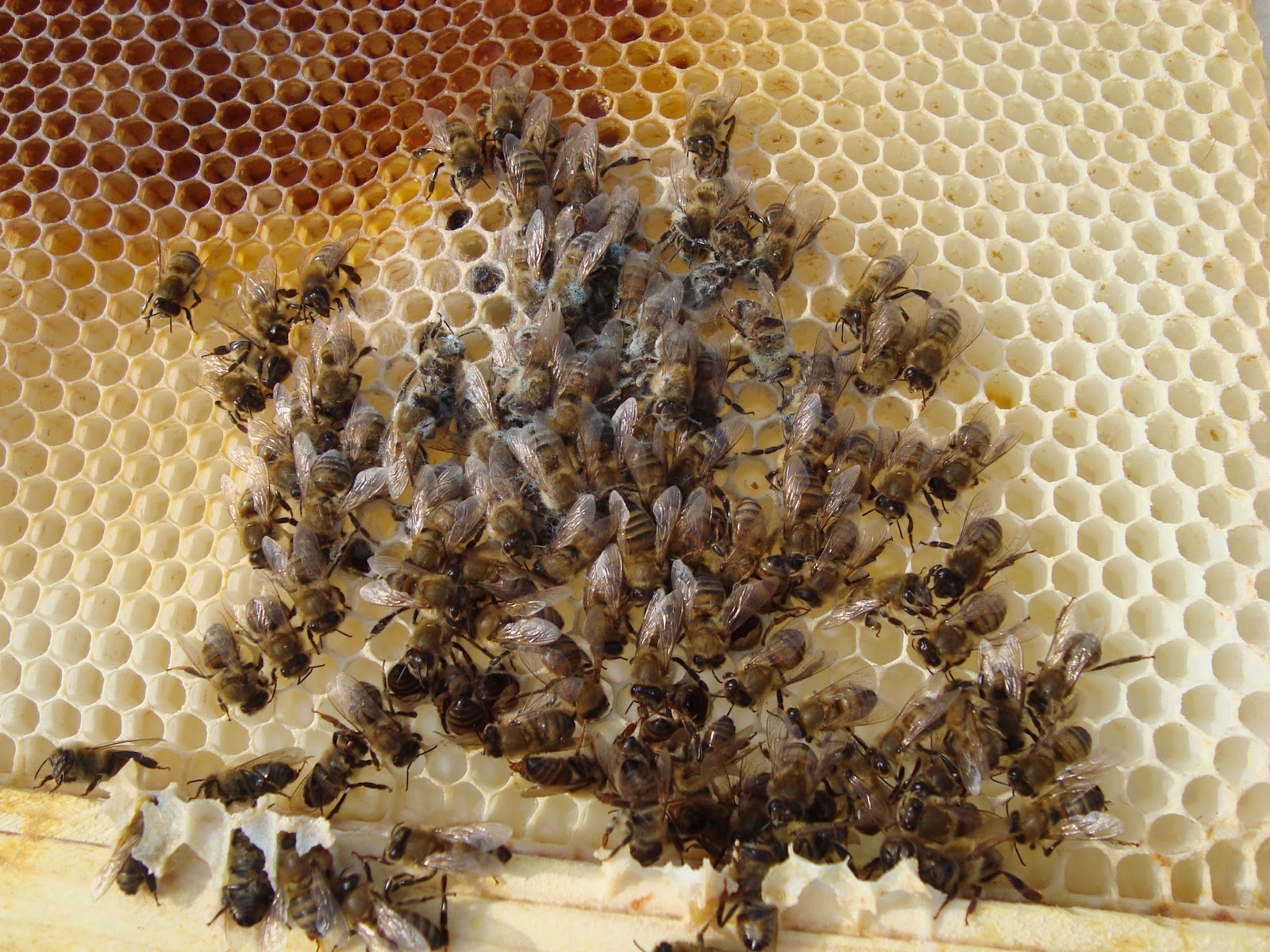
2. The white: Not too many dead bees, but small population of adults. We noticed that this hive had some new brood from this spring, and plenty of food. But probably not enough adult bees to keep them warm. And when a cold snap or cold nights came again, the honeybees' duty were to protect the brood and thus did not move to the food, and died in situ. Sad.
| Small adult population |
| Bees trying to protect the small brood: losing their lives in the process. Notice on the lower right side: little butts poking out...bees starved looking deep for food. |
| Small amount of brood:dead |
| Bees dead very close to some pollen,upper left |
| Molded dead bees |
| "Scaredy" wet, cold mouse |
4. The other green one: Got completely robbed at the end summer, too small of a hive to defend themselves. Died fighting.
Last words:
Ben and I take comfort in knowing that we did all we could for our girls last summer and fall; we truly love our bees and were extremely overcome by this horrific scene. However, spring is for hope, and rejuvenation. And hope we do have for another season, with strong youthful packages of bees and their revered queens. Confidence and optimism are the motto of this honeybee season!
Sunday, March 04, 2012
A Little History
![]() |
| The Mayflower, Google Image |
"By 1621, the Virginia Company was sending ships loaded: "with divers sorte of seed, and fruit trees, as also Pidgeons, connies (rabbits), Peacok masstiffs, and Beehives,"" (Bees in America, T. Horn).
However, there are more than 4,000 native bee species in the United States, that were present when the imported honey bee appeared. It is believed that the European dark bee (Apis mellifera mellifera) was domesticated in modern times, and taken to North America in colonial times.
![]() |
| German or Black Bee. http://aramel.free.fr/INSECTES18terter.shtml |
After two seasons with Italian bees, and our adventures raising them in Minnesota where the climate is harsh, with long Winters and almost non existent Springs and rather short Summers. In addition to the Varroa mites that can decimate a colony in one season. I have decided to buy a colony of Russian honeybees. My husband and I will be installing them on a private, prairie restored land in Chanhassen in late April.
Why? Because I came to the conclusion that maybe the Italian honeybee is not the best one for my region; it is however the most popular and the one highly recommended for beginners but maybe not the best.
![]() |
| www.ars.usda.gov Experimental yard in Khorol, Primorsky ~ 200 Km NW of Valdivostok |
Don't get me wrong I still love my Italian bees, how could I not? They are beautiful!
| Our Italian bees hanging on! |
| Our Italian bees being happy! |
Subscribe to:
Posts (Atom)