Raising Honeybees in the Suburbs

After taking a few entomology classes at the University of Minnesota. I discovered with fascination the world of insects, especially honey bees. It will be my seventh year as a beekeeper and I am sure a new adventure as well.

Saturday, January 01, 2011

Happy New Year 2011


WE WISH ALL OUR FRIENDS AND FAMILIES A WONDERFUL HAPPY NEW YEAR !

Friday, December 24, 2010

Merry Christmas!

December 24, 2010

I wanted to let you know that the bees are fine and cozy in their respective beehive. As many of you know, here in Minnesota we have had a lot of snow so far, and somewhat colder temperature than usual.
The snow is fine for the bees, it acts as a natural insulator. As for the cold, well the honeybees have to cuddle a little tighter, and rotate like penguins to keep their little clustered buddies warm. With their constant movements, the bees generate warmth...if we were to put our hand inside the beehive into the cluster, we would be surprised to feel 80 degree F (23C). However, the hive itself is cold just like the outside temperature. Unlike us who need a heated home during winter, the honeybees need to be warm themselves to survive. By eating the honey that we left them, and moving their tiny legs, they have that incredible capacity to survive the cold.

We wish our friends and family a Merry Christmas!

Saturday, November 06, 2010

The Last Chore

On the first week of November, Ben and I did our last chore at the apiaries. It was a beautiful sunny day but somewhat a little cold 42 F (5 C), but I had to remember that it was November. As we approached the 2 colonies in Chanhassen, Ben who was walking in front of me and seeing the hives before I did, got a little agitated. "Where are the bees? I don't see any bees...Oh! They 're all gone, I can't hear them...where are they?" We opened the first hive body... nothing...no bees, no sounds. We removed the first hive body and put it aside, and there our bees were sitting pretty and calm on top of the second box. They had managed to scare us, one more time! But then they saw us and came out, flying gently around us, as to say: "Hey, we are here do not worry!" I whispered to them to have a safe and healthy winter, and that we will be back in the spring. I petted few of them gently. It is funny, I think they knew that was it for the season.

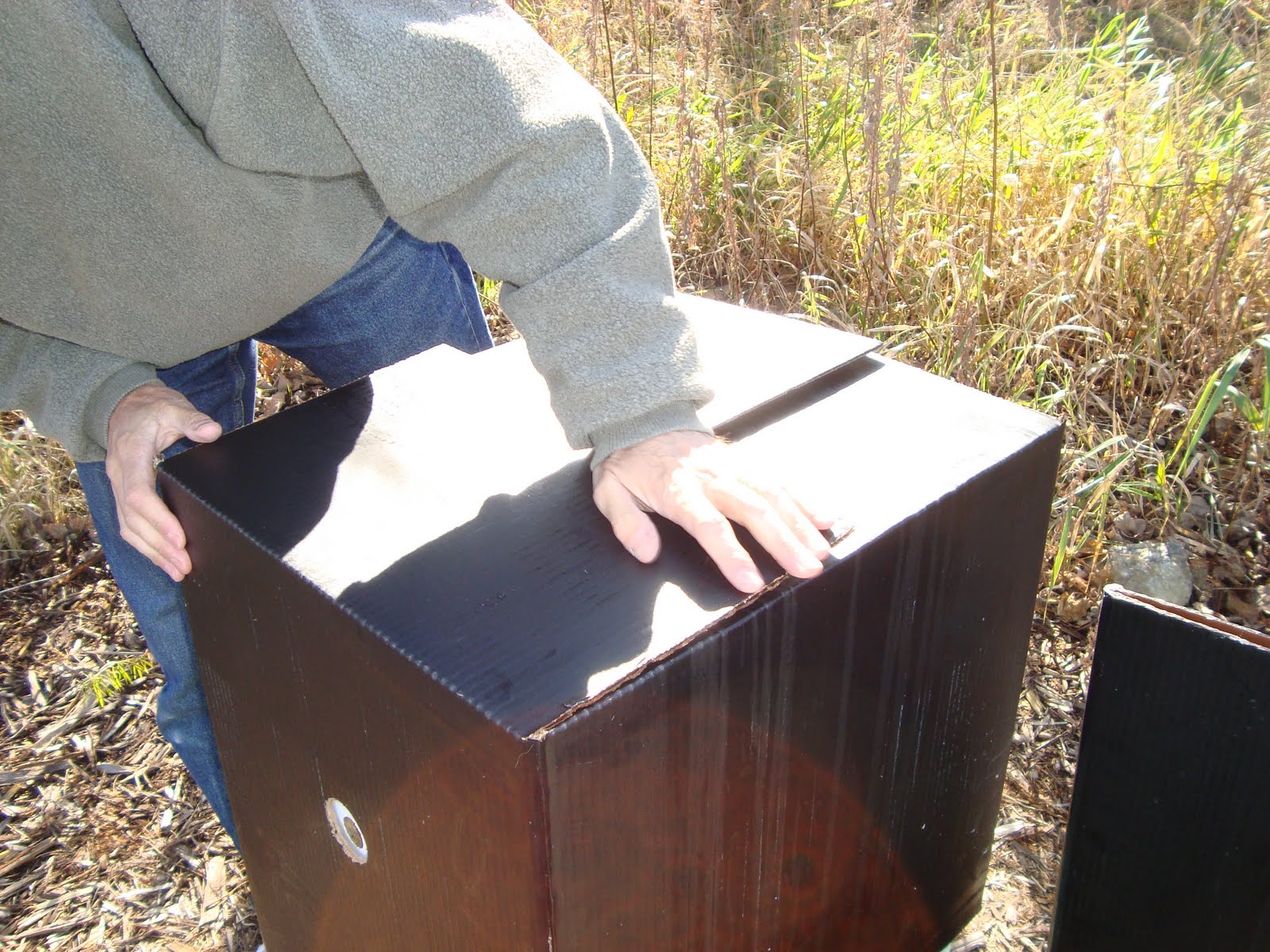
After my goodbyes Ben proceeded, to place an absorbing wood board on top, and then slid a waxed cardboard carton over each hive to protect the honeybees against the frigid Northwest wind. He replaced the covers and put many rocks and bricks on them to make sure they will stay put. We then backed away, looked at the hives one more time wishing them well. We walked slowly to our car. That was it, the season was over. There is nothing else we can do for our precious honeybees. They are on their own, and we really wish them to be successful and be healthy and strong come next spring.

We repeated these last same steps in Shakopee. The golden Italian bees had returned to their own hive. The darker Carniolans were at peace in their own hive... they have fought an aggressive invasion in October, many died and they lost some honey. Hopefully they will have enough food to survive. I waved goodbye, and wished them well.

What an adventure it has been, and despite the ups and downs, the unknowns, and strange happenings; we enjoyed every minute of it. And along the way the bees taught us a lot: first of all they are a capable species that is combative, hard working and self reliant.

We wish to all our friends and families a good, safe and healthy winter. Thank you for being interested in bees. During the winter months I will be posting what we are doing and thinking for next year, and please if you have any questions, I would be happy to answer them.

"Bee" well,
Karine


In Chanhassen

1. Ben placed a moisture board on top.


2. Now the cardboard.

3. Ben closes the carton, leaving the exit hole open.
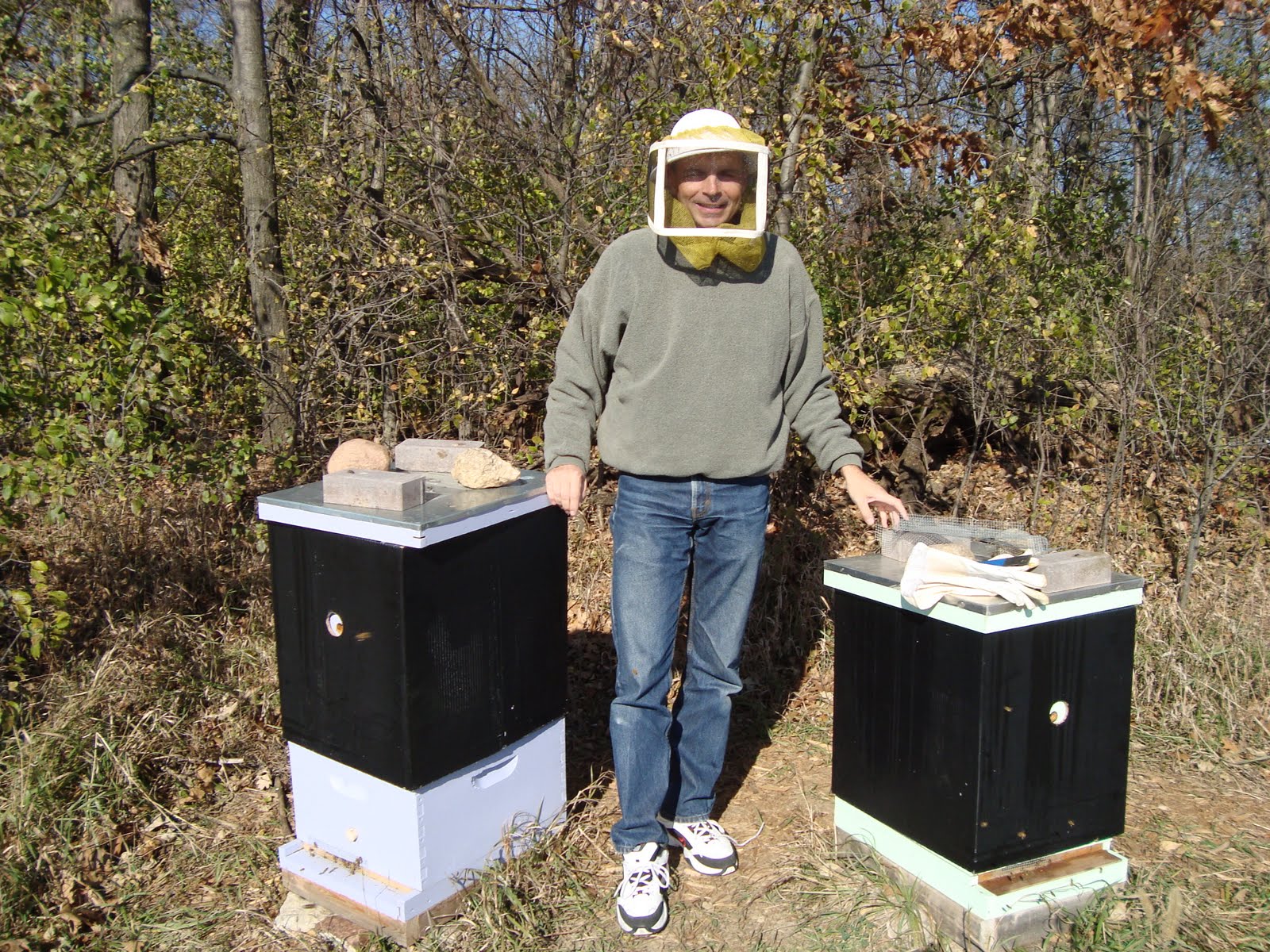
4. Voila! Ready for winter.


In Shakopee

1. Moisture board in place, and carton next.


2. Yes! well done!

3. Placing the cover a little
"crooked" to let the moisture escape.
Look at those 2 beekeepers....they look so proud!!!!

Karine at the Chanhassen apiary and Ben at the Shakopee apiary.


Friday, November 05, 2010

Be Well, Have a Safe Winter

Look our 2 hives in the background

November is finally here, and the honeybees have slowed down considerably. Even if like other insects, they are cold-blooded; they do not die off or hibernate like them. They are active all winter eating and transforming their accumulated honey and pollen to keep warm.

Since the cold weather started the honeybees have organized themselves in a tight cluster, moving their "back legs" muscles intensely to generate heat and to warm the cluster. Unlike us who need a warm home during winter, the bees need only to be warm themselves, and sharing this warmth among the group.

Something extraordinary happens to bees at the end of summer. The bees that are born in the Fall are different than the bees born in the Spring or Summer. So the so called "Winter" bees have a different blood protein, they are fatter which help them during the non-foraging months. They also live longer, from 4 to 6 months. Summer bees' life expectancy is about 45 days! However, those Winter bees have a daunting task... they have to get the colony through the winter. But they have prepared themselves since about August; the population is now smaller, and brood production is halted. Everything has slowed down.

Honeybees are geniuses! The cluster that they form will expand and contract as the outside temperatures go up or down. As temperature decreases , the cluster thus becomes tighter and tighter. The inside of the cluster is able to maintain a temperature of 85-90F! While the outside layer of bees can reach and maintain 55F. Extraordinary! The bees rotate...they take turn to be on the outside, protecting the core where the queen is located during the whole winter. This outer "coat" of bees always touches the honey stores. The honeybees eat during that time making sure to pace themselves as to preserve the food which HAS to last until April. That's 6 months of food reserve! I don't have 6 months of reserve in my pantry... How about you?

Tuesday, October 19, 2010

Preparation for Winter

The last 24 days have been spectacular in Minnesota. No rain, plenty of sunshine and above normal temperatures. However, the honey bees know that winter is around the corner, and they have been busy getting ready. The queen by now is laying fewer eggs, knowing that the food will be rationed for the next few months. Foragers are still going out and about collecting the little precious nectar left and the priceless pollen. This is also becoming a rarity as the flowers are mostly spent. Right now, the bees' activities are done later during the day than previously as the temperatures are lower in the morning, impeding them. However we can still see them hovering around flowers late morning and early afternoon. Then the honey bees seems sluggish again, and just walk around the hive, or fly nearby.
As beekeepers we still have one more thing to do before we "tucked them in" for a long winter and say: "Have a good and safe winter!" So, in order to protect our bees against the wind, we will plug the bottom holes with cork and we will wrap each hive in a waxed cardboard, making sure that we leave one opening at the top for the bees to get in or out as weather permits. Ben has been cutting out perfect little holes in our cartons. We will wrap them up sometimes during the first week of November. Then our job as beekeepers will be done until March! However in the meantime we will build more hives, order new bees and queens...and thinking about next season!


This is how the hives will look like
in the fields.

Tuesday, October 12, 2010

Pessimism is Lurking


Italian bees are still trying to get into Carniolans' hive despite the
contraption to slow them down.


The Green beehive in Shakopee which has been " rescued" many times over the season: Losing a queen, adding a new queen, honey bees killing the new queen, adding a nuc ( 5 frames of brood, nectar, pollen, Caniolan honey bees and queen), battling mites, and ants, feeding them, building a "super" structure to slow down robbing by their next door neighbors the Italians bees. It is not because we did not try to help them, we did really try very hard. However, after seeing the colony yesterday...the robbing continues, the fights are numerous around the entrance, and the Carniolan seem overwhelmed, and overpowered.

Fights among the bees.


The colony is robbed because it is weak, and nature knows, it will not survive. Even with all our ingenuity or because of my stubbornness to save the bees by feeding them some sugar syrup earlier, and protecting them; I have reached yesterday the sad and somber conclusion that it is really doomed. This colony cannot survive on this meager sustenance The Italian bees are stealing their honey; the Carinolans' reserve needed to survive the winter.

Ben looked at some frames, and not much honey was left for the Carniolans. Although these type of bees make a smaller cluster when the cold arrives and thus need less honey to feed the colony, the reserves are dwindling and insufficient.

I feel sad. I really thought that I could save them. But I guess I knew deep inside that it was a lost cause but I had to try, I had to hope. No one can win against Nature... she always wins. However, I take comfort in the fact that I gave it all. No regrets.


More fighting and trying to get in.

Monday, October 11, 2010

Mysterious Illness of Honey Bees: CCD Colony Collapse Disorder

In a recent article which I read with interest : " Iridovirus and Micosporidian linked to Honey Bee Colony Decline" published October 6, 2010 in the Scientific Journal PLoS ONE; Scientists have found new 2 unreported RNA viruses in North America which live in honey bees. It could be a clue to the cause of CCD (colony collapse disorder), which in recent years have decimated the American honeybee population by 40% with no known scientific causes so far. Many causes have been suggested to the mysterious disappearance of bees while overwintering: viruses, parasites, fungi, pesticides, malnutrition and stress, in combination or not. Some ideas have been already refuted.

However, a team of scientists with the help of the U.S. military, discovered as I mentioned two new viruses : Varroa destructor-1 virus and Kakugo virus, together called: IIV (invertebrate iridescent virus...no need to know that really!)
What is interesting to note is not only the IIV seems to be associated with the honey bee collapse, but paired with Nosema ( a common fungal bee disease which can be controlled) has been observed to be lethal to bees from samples taken from commercial apiaries across the USA. In comparison, the pathogen pairing was not observed in samples from colonies with no history of CCD. This important finding then could suggest that bees co-infected with those 2 pathogens at the same time is eminently more lethal to honey bees than either pathogen alone.

However like any viruses IIV is vulnerable and can't replicate at very high temperatures (85 F). As beekeepers we may receive some instructions on how to protect our bees in the near future but it seems to me that just like humans when our immune system is weak, the chance to get sick is greater. So maybe by controlling the overall good health of a colony of bees would help. Still a lot of questions remain with no clear answers.

Article: http://www.plosone.org/article/info:doi/10.1371/journal.pone.0013181