Raising Honeybees in the Suburbs

After taking a few entomology classes at the University of Minnesota. I discovered with fascination the world of insects, especially honey bees. It will be my seventh year as a beekeeper and I am sure a new adventure as well.

Tuesday, April 30, 2013

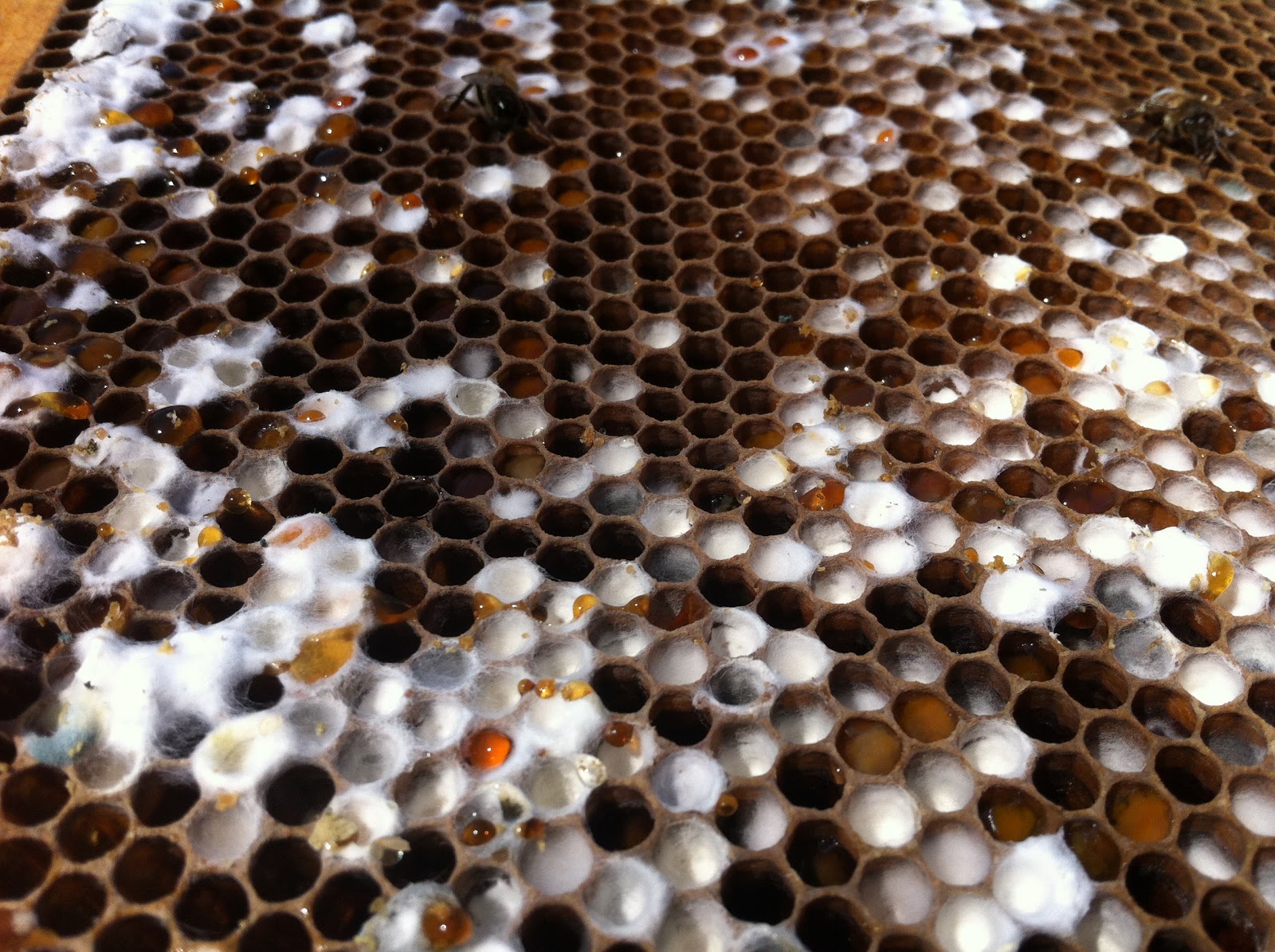
Mold , Mildew and Blue Cheese!

Mold on frame  Photo: Liz Vogel

Last week when my husband and Liz were cleaning up the hives, they saw few frames that looked like this one above.  Moldy and plainly ugly! They were a bit worry at such discovery. Of course it is unsightly but there is absolutely no need for concern. Mold and mildew are not diseases, and are not contagious. The few frames that were moldy were found in a hive were honeybees had already perished. The mold did not cause the colony to die.

This phenomenon happens when the humidity level in a hive is too high. This happens when there are not enough bees to ventilate the hive, or when the hive is in decline, or dead. The usual culprit is a mold called : Penicillium waksmaii, which apparently inhibit the growth of certain bacteria!

Interestingly, the mold will not damage the wax, therefore, there is no need to discard the frames, or to clean them ourselves. The bees are champions as far as cleaning goes...they are "cleaning gurus". All we have to do is to place those frames in a strong and healthy colony and the honeybees will take care of the problem. They will clean and polish every cell in a few days. This "special cleaning" is not a real burden for the bees because they always clean old cells thoroughly before re-using them for brood, honey, or pollen.


Let's think about this for a minute....Blue cheese is a general classification of cow's milk, sheep's milk, or goat's milk cheeses that have had cultures of the mold Penicillium added so that the final product is spotted or veined throughout with blue, blue-gray or blue-green mold, and carries a distinct smell, either from that or various specially cultivated bacteria.

I love blue cheese a lot....which is of course full of mold; I eat mold! But the bees don't, they clean it! What a world!


Sunday, April 28, 2013

The Big Spring Day!

Left over snow from Monday(4/22) snow storm!

Sunday, April 28, 2013

Now we may dare say that spring has arrived! Finally! It is now 77F (25C), a bit warm for spring but I think that I should not complain as it could be worst..we know.

 Friday April 26, 2013 was a big day for the bees...lots needed to be done to get them ready for the nectar flow which will eventually arrive!


This represent a hive with 2 boxes, upper and lower box. In the fall, the bees are reside in the bottom box, and the food reserve (pollen and honey) is on top. During the winter months, the bees eat their reserve. Slowly as spring approaches, the bees gather in the top box and queen starts laying her eggs at that location in empty cells. By now the bottom box is empty. Because it is in the nature of bees to go up (like in a tree trunk), we have to rotate the boxes to simulate that upward motion! This permutation gives them a lot of space and is also supposed to prevent swarming (leaving the crowded nest). So, Ben did that rotation to every hive, some boxes still full of food were very heavy. He also clean the dead bees accumulated at the bottom of the hive, and gave them a larger bottom entrance.

Since, we don't have flowers yet. He gave each colony 2 buckets (2. lb, or 7 L)) of  sugary syrup, to sustain them until the dandelions show up! Apparently the honeybees had plenty of pollen patties left, so none were added anywhere.
Sugar syrup

In this endeavor, Liz helped him in Chanhassen. Smoking the bees was a smart thing to do that day! It was warm and they were flying in and out. Ben noticed that they were coming back with a little pale yellow and orange pollen on their legs... I wonder where in the world they are finding pollen right now!

I know that they will gather the tree sap before the flower nectar is available to them...they are smart. During this spring cleaning, Ben expelled 3 mice from under one hive...probably a family. It is a very nice adobe for them during winter...warm and plenty of food!

After 4-5 hours of heavy lifting, Benoit came back home happy ; the honeybees were on their way to a new season. We wish them well!

Thursday, April 04, 2013

R.I.P


April 4 2013
I visited the beehive in Chanhassen, the one that we suspected  that was very small and weak with Nosema. Since it was going to be above freezing overnight now; I was going to give the honeybees some sugar syrup to help them recover...Alas, they were all dead. We have now 5 hives. 5/7 made it so far. That's 71% survival rate...still better than the national average but very, very sad.

Wednesday, March 20, 2013

HAPPY SPRING!!!
Today is the first day of spring! It is 8F (-13C)... Brrrrr......that is cold.  I was listening to the radio yesterday and heard that the groundhog Punxsutawney Phil has been fired :)


Russian Hive in Chanhassen

Spring in Minnesota!


Actually these frigid March temperatures look like January...what a huge step back. I wonder how the bees are going to make it . Foraging might start very late this year... the ground is still frozen, and  has many inches of snow.


We checked our hives again on March 17, 2013. They are  still alive but now we are worried because it is still cold, and the honeybees are going to run out of fresh food. They have some reserves from last fall, like honey and  pollen but they will not go out and forage soon. It is a vulnerable time for the honeybees. Of course we are giving them pollen patties, but now the queen has been  laying eggs for few weeks and most bees are busy covering the brood to keep the next generation warm. Since this is the utmost job, it takes precedence to eating. It is true honeybees would rather starve to death than leave the brood unattended, in order to save the species. But they don't know that if they don't eat, all will perish.  I guess I have to have faith in nature. We will see.

Monday, March 04, 2013

Bees are Alive!!!

See the little bees!!!

Benoit and I went to visit our hives yesterday , March 3 2013. We were getting nervous by all the reports that I was reading coming from all over the US, plus from the beekeepers right  here in Minnesota. Everyone was reporting heavy losses... we could not wait any longer.

6/7 hives survived! We are so happy!!!! However, we still have the month of March to battle, we may have another cold snap, and that is dangerous for the bees. The queens are already laying new eggs and little ones are being born, they are vulnerable at this early stage of life. We also gave each colony a pollen patty, so they won't starve before the first bloom. 

Some honey bees were very curious, and came out to see what was the commotion all about. Benoit put 2 little bees back in the hives, because it was cold and they  had trouble going back home. He also got his first sting of the year :( It is a good thing that it does not react at all. It happened when we were closing the hive and the bee got stock between his fingers and the cardboard. 

Keep our finger crossed for a peaceful March.

Next visit in 7-10 days!

Saturday, March 02, 2013

Spring is in the Air!

Willow in my herb planter, last summer!


I know spring is close when Willow, our 11 year old cat wants to go on the deck to check things out! She never goes outside after Halloween, and start asking to go out when the temperatures are on the rise. I don't know how she knows...but she is always right :)

On the bee side, I am still hopeful that they all made it through the winter. I am planning on checking on each hive in the next 10 days,or so. However, I hear and read a lot about honey bees that did not survive, and not having enough bees to pollinate the crops this season. 

It is still a little bit too cold to open the hives, and take a look. When the temperature will be around 40F (4C), I will give the bees a pollen patty if they need it ( meaning if they have eaten all their supply already). Remember , the first dandelions are in bloom around April 15. However, some trees like the willows,  maples and few others will be blooming before that time.


I gave a presentation about the honeybee through time, at the Arboretum in February to a group of wonderful ladies. I really love to talk about honeybees, beekeeping and pollinators. I am always amazed how much people know about bees and their difficulties. The questions asked are always pertinent and the desire to learn is great. I love it!

It is not to early to think about planting a pollinator garden. Native plants are the best! Those little "oasis" of good pollen and nectar sources are wonderful not only for my golden darlings but also for hummingbirds, butterflies,  bats, and bumblebees.

Wednesday, February 13, 2013

Spring in California: Almonds and Bees

It is not a rumor anymore...many beekeepers are reporting a lot of bee losses this year, up to 90-100%. This is devastating. I won't know the fate of my own bees for another 3 weeks or so. This report comes from California, Eric Mussen (Apiculturist in the UC Davis Department of Entomology since 1976) suggested that this spring 2013, California may face a shortage of bees pollinating their almonds orchards. As many beekeepers noticed, last year was a bad year for honey production in the United States. The bees did not have enough to eat due to a lack of pollen and nectar in some regions. Bee nutrition is becoming a huge topic of discussion among scientists, as it is an important factor associated with CCD( Colony Collapse Disorder). The view is that if a bee is not well fed (just like us),  she becomes weak and more susceptible to pests and diseases.

Hives in almond orchard, CA
(photo: entangled bees-tumblr.com)

The state of California is the largest exporter of almonds in the world; 80% of the global supply of almonds is grown there. 70% of the harvest is exported. This year forecast states that 2.10 billion of meat pounds will be produced (National, Agricultural, Statistics Service) which is valued at about 3 billion dollars!

Every year almond orchards need 1.6 million colonies  or about 2 colonies per acre to pollinate the trees properly. California has about only 500,000 colonies this year. Because of what is happening to the little bees (winter loss), there will be less colonies and they  will be less populous. Usually almond growers would like to have at least 8 frames of bees per hive to ensure that the efficacy of pollination. But this year, they will be lucky if they get 6 frames of bees... this is 1/3 less bees per hive to pollinate the same amount of trees!


Besides the honeybee situation, weather has to cooperate as well! If it is too cool, fertilization may not happened. The pollen tubes that are located at the base of the flower may not grow properly, thus not reaching the ovum (lower portion of the pistil containing the ovules or female parts).


 What is called a good "nut set", the beginning of the development of (in this case), the almond occurs in the first 3 days of pollination,and at the most within 5days. On the other hand if it is too warm, the tissues dry out and die, not producing a potential nut!

Almond season is very short in California, about 2 weeks, depending on almond cultivar and the weather.  On average, full bloom happens usually on Valentine's Day, February 14!


Hopefully the honeybees in California will be able to handle the immense task that is ahead. As for me, I will still wonder how my bees are doing this winter....but no peaking until warmer!